How Much Food & Water For Emergencies & SHTF?
I want to start with a picture that’s burned into my memory: a road that isn’t a road anymore. Just a gaping wound in the earth where pavement used to be, water still rushing through. No cell service. No electricity. And somewhere up in those mountains, my brother and his wife, and I wasn’t sure if they were okay.
That was Hurricane Helene, real life SHTF. And it changed everything about how I approach emergency preparedness.
My Video on Food and Water for Prepping
My Old Advice Was Wrong
For years, I told people to store one to two weeks’ worth of food and water. It felt like a reasonable buffer, enough to ride out a bad storm, enough to stay comfortable while waiting for help to arrive.
Then I went down to Tennessee and North Carolina for search and recovery operations after Helene hit, and I realized pretty quickly that one to two weeks isn’t enough. Not even close.
What I saw down there was people completely cut off. Not just inconvenienced, trapped. The bridges were gone. The roads were gone. And because they couldn’t get out to reach the community supply points set up at churches and private compounds, none of that generosity could reach them either. It didn’t matter that people wanted to help. Getting to them took time. A lot of time.
That’s why I now recommend a minimum of four weeks of food and water. And honestly, if you can push toward eight weeks, do it.
Here’s the thing people don’t want to hear: when disaster hits at that scale, you are not waiting for your government to come save you. You’re waiting for your community to find a way in. And communities, even the most motivated, most resourceful ones, need time to organize, to clear debris, to build routes where routes no longer exist. Four weeks gives that process time to actually happen.
Building Your Food Supply Without Breaking the Bank
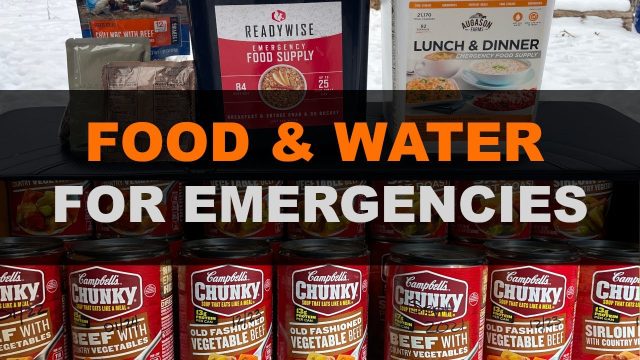
Getting started doesn’t require spending a fortune. The way my wife and I began was simple: every time we went to the grocery store, we’d swing through the canned food aisle and look for sales. Buy one, get one free? We’d grab anywhere from four to twelve cans. That’s it. That’s the whole strategy, at least at the beginning.
Over time, those cans add up into a real supply. We write the date right on the label so we can rotate through older stock first. On nights when we don’t feel like cooking, those cans come off the shelf and get used. Nothing goes to waste.
Pre-packaged food buckets, the kind from emergency supply brands, are worth having too. They stack easily, they’re dense in calories, and their shelf life is enormous. But I want to be honest with you: most of them are loaded with oatmeal, sugary drink mixes, dried potatoes, and instant beans. That’s not going to feel like real food after a few weeks, and more importantly, it’s almost entirely lacking in protein. If you’re stuck on your property for a month, doing physical work clearing storm damage and hauling supplies, your body is going to need more than carbohydrates.
That’s where canned meats and, if you’re willing to put in the work, home canning come in. My wife cans venison from our deer harvest, beef from a local farmer we trust, homemade jams, pickles, and vegetables. Imagine having a jar of stew you made yourself, real meat, real potatoes, real fat, sitting on a shelf waiting for an emergency. That’s a completely different situation than choking down instant oatmeal for the fourth week in a row.
So my recommendation is to diversify. Start with store-bought cans. Add a food bucket or two for the calorie density. Then, if you want to take things further, learn to can your own food. Each layer makes you more resilient than the last.
Water Is Non-Negotiable
If your budget is tight and you have to choose between building up food first or water first, choose water every single time.
The human body can survive roughly three to four days without water. That’s not much room for error, and that window shrinks fast when you’re outside doing hard physical work in the aftermath of a storm. When I was out in North Carolina chainsawing through debris and searching for my brother, I was going through water at a rate I hadn’t anticipated. Hydration isn’t just survival math; it’s the difference between being able to function and not being able to function at all.
The standard recommendation you’ll see is a half gallon of water per person per day. I think that’s too low. Based on what I experienced, I recommend planning for at least one full gallon per person per day. It accounts for physical exertion, basic sanitation, and the fact that emergencies are rarely as clean and simple as the planning guides suggest.
Bottled water is the easiest and cheapest starting point, a few bucks at the grocery store for a whole brick of it. Yes, there are concerns about microplastics from long-term plastic bottle use. But I’m talking about emergencies here, not lifestyle choices. When the alternative is dehydration, the plastic bottle wins.
From there, you can move into larger potable water storage tanks, 25 or 30-gallon containers, kept in a basement or somewhere accessible. These scale up your supply without taking over your living space.
I also carry a Sawyer straw filter everywhere I go in the field. It can pull drinkable water from just about any source, including muddy puddles. In a true emergency where your stored water runs out, something like this is a lifesaver. But I want to be clear about one important limitation: having a filter assumes you can safely reach a water source. In North Carolina after Helene, getting to the rivers meant wading through five, ten feet of silt, navigating fallen trees and debris, and doing it all while there was still material floating downstream that could injure or trap you. A filter is a backup, not a primary plan. Stored water on your own property is the primary plan.
The Mindset That Actually Makes This Work
The biggest barrier to emergency preparedness isn’t money or space or knowledge. It’s the feeling that you have to do everything at once.
You don’t.
My wife and I didn’t wake up one day and build eight weeks of supplies from scratch. It took years of consistent, low-pressure effort. A few extra cans here. A case of water there. A weekend of canning venison in the fall. It built gradually, and because it built gradually, it never felt overwhelming.
You don’t have to live in fear to be prepared. You just have to keep it in the back of your mind and act on it a little at a time. Grab a few extra cans next time you’re at the store. Pick up a case of water. Start there. That’s genuinely, meaningfully better than nothing, and it’s a foundation you can keep building on for as long as you want to go.
What Hurricane Helene showed me is that the people who came through those weeks in the best shape weren’t the ones waiting to be rescued. They were the ones who had already made small, steady preparations before the storm ever showed up on a weather map. I’d rather be in that group. I think you would too.